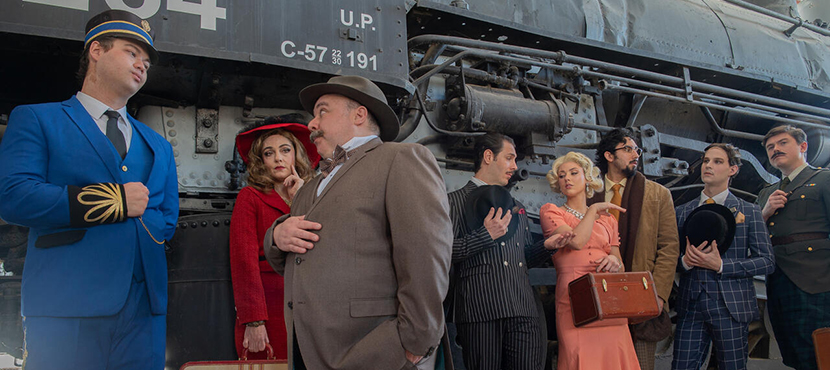
For this large-cast performance, I curated the evening program, interviewed the director, Sean Boyd, and wrote the following:
Dramaturg’s Note: An Entertaining School for Husbands and Wives
Shakespeare’s The Merry Wives of Windsor likely premiered on St George’s Day, April 23, 1597. Although staged at Westminster in London, in the presence of the Queen and on the occasion of the yearly feast honoring the Order of the Garter – an aristocratic fraternity – the play is the author’s only “citizen comedy,” a genre that hinged on the everyday life of the middle class. In terms of his intended first audience, Shakespeare thus seemed to heed the classical notion – at least as far back as Greek philosopher Aristotle’s Poetics (335 BCE) – that, while tragedies depict characters in higher positions such as kings and heroes, comedies should instead provoke laughter by making fun of those “lower” than the spectators.
This comedy – set in the countryside town of Windsor, west of the capital – also adheres to the precept that art should both entertain and teach, suggested by Roman poet Horace’s The Art of Poetry (19 BCE) and revived during the Renaissance. The main embodiments of these conjoined aims are of course the titular wives, Mistress Ford and Mistress Page, who orchestrate the juiciest opportunities for both fun and learning. Even though the Windsor society still revolves around marriages arranged around patriarchal considerations of how to accrue wealth, it’s women here who lead the action and have an equal say about dowry money.
As for the teaching, the title itself is a clue that the play is a “school” especially suited for married folks: by losing their competing bets to have their daughter Anne marry the men they chose for her, Master and Mistress Page learn that economic considerations ought not to eclipse the need for true love between husband and wife. In turn, Master Ford realizes that he must trust his wife more and that misplaced jealousy only reduces him to a fool.
The main target of the comedic medicine against interference with healthy marital relationships is of course Sir John Falstaff, the overweight, lying and cheating knight who is so vain and full of himself to believe he’ll seduce two married women at the same time. Instead, he is thrown into the river Thames along with dirty laundry, beaten up in his disguise as an elderly woman, and finally scared to death by town children dressed as elves and goblins. Instead of cuckolding others, he ends up wearing the horns himself.
If characters like Evans, with his Welsh accent, and Caius, with his French one, draw on more superficial national stereotypes to elicit laughter, Falstaff’s genealogy goes much deeper: not only did the same character appear in the historical plays Henry IV Part 1 and 2 – where he keeps company with Prince Hal, the future King Henry V of England – but his role is here firmly rooted in the Italian commedia dell’arte Capitano, an equally boisterous stock character whose primary dramatic function is to disrupt existing couples. Of course, instead of commedia’s naïve lovers, the women here are much more mature, wily, and persistent, unafraid of tempting Falstaff time and again as he never seems to learn the lesson.
And since there’s nothing more satisfying than making fun of an “immoral” scapegoat, Mistress Ford and Mistress Page eventually enlist not only their own husbands but the entire town to make the point that even married folks can be both merry and honorable. Indeed, the play’s only successful seduction of a married woman is executed by “Brook,” i.e., Ford himself in disguise tempting his own wife. In the end, in proper comedic fashion, no one is excluded from the collective joy of learning that the societal network has remained strong against attacks to its most precious connections.